Heat, batteries and departure time
Internal combustion engines discard roughly two-thirds of the fuel’s chemical energy as waste heat, making winter cabin warming almost free. Because an electric drivetrain is around 85% to 90% efficient, an EV must generate or scavenge heat deliberately. Knowing how your vehicle’s thermal loops work—and using scheduled departure timers wisely—lets you step into a de-iced, comfortable cabin without sacrificing driving range.
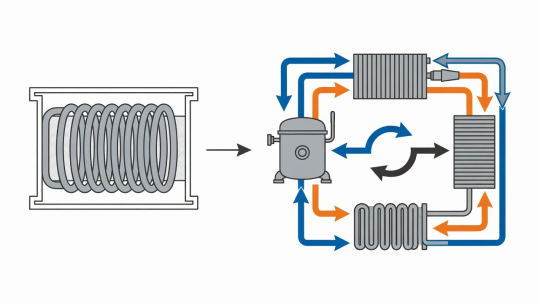 Cabin & pack hardware
Resistive PTC Heaters vs Scavenging Heat Pumps
Electric vehicles rely on two primary heating technologies, often working together inside a unified glycol coolant manifold:
Positive Temperature Coefficient (PTC) Heaters: Ceramic resistive elements that warm either air or liquid coolant directly. They respond almost instantly and work reliably at -40 °C, but their Coefficient of Performance (COP) cannot exceed 1.0: every 1 kWh of heat delivered costs exactly 1 kWh of battery energy.
Vapour-Compression Heat Pumps: By compressing refrigerant and scavenging low-grade heat from ambient air, the drive inverter, electric motor stator and battery pack, a modern heat pump achieves a COP of 2.0 to 3.2 between +7 °C and -7 °C—cutting steady-state heating energy by 30% to 50%. Below -15 °C to -20 °C, ambient heat extraction diminishes and supplemental PTC elements assist.
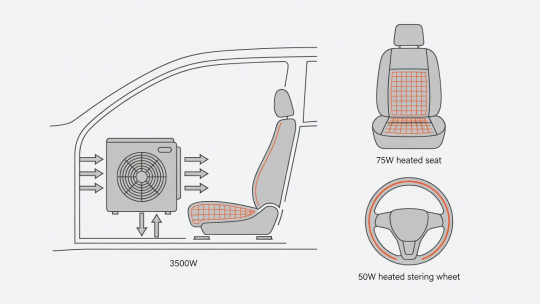 Targeted comfort
Conductive Contact Warmth vs Cabin Air Volume
Look at the wattage numbers inside the cabin and the easiest range-saving habit becomes clear:
- High-voltage cabin air heater at startup: 3,000 W to 6,000 W
- Steady-state cabin air maintenance at -10 °C: 1,200 W to 2,200 W
- Heated seat cushion & backrest (per seat): 45 W to 90 W
- Heated steering wheel rim: 40 W to 60 W
Lowering the climate control thermostat from 22 °C to 19 °C while turning on the seat and steering wheel heaters keeps your body warm immediately through direct contact while trimming 300 W to 600 W of continuous HVAC draw.
Plugged-In Departure Timers vs Unplugged App Remote Start
Most electric vehicles offer two ways to warm the car before you walk out the door: an instant "Climate On" button in the smartphone app, and a scheduled "Departure Time" timer in the vehicle settings. They do not always behave the same way.
| Scenario | What Warms Up | Energy Source Used | Best Use Case |
|---|---|---|---|
| Scheduled Departure Timer (Plugged into Level 2 Wallbox) | High-voltage battery pack (+10 °C to +15 °C target) AND cabin air, seats, steering wheel and windscreen. | Mains grid power via the wallbox (preserves 100% of available battery SoC). | Morning commute or long winter road trip departure; restores regenerative braking from kilometre zero. |
| Manual App Climate Start (Plugged In, 15 Min Before Leaving) | Cabin interior, glass defroster, seats and wheel (some models also warm the pack if below 0 °C). | Mains grid power (up to EVSE amp limit). | Unscheduled errands when the car is sitting in the driveway on the charger. |
| Unplugged App Climate Start (Parked at Work or Trailhead) | Primarily cabin air and windscreen defroster to melt snow and ice for safe visibility. | Traction battery (typically consumes 1% to 3% SoC over 10–15 minutes). | Clearing iced windscreens before driving home; avoid running for 30+ minutes if battery SoC is low. |
Preventing Window Fogging While Using Eco Climate Modes
A common mistake during a driver’s first EV winter is pressing the "Eco+" climate button AND manually forcing the ventilation system into full air recirculation to trap warm air inside. Within ten minutes, moisture from wet snow on floor mats and passengers’ breath condenses against the cold glass, fogging the windscreen and side windows.
Follow these three rules to keep glass crystal-clear without wasting energy:
- Leave Fresh Air Intake Automatic and Keep A/C Enabled: Even at -5 °C, the climate system uses dehumidified exterior air to keep cabin dew point below the temperature of the glass. Never lock recirculation on in winter.
- Shake Snow Off Boots and Use Rubber Tray Mats: Standing water soaking into fabric carpets evaporates whenever floor vents blow warm air, creating constant window misting that forces you to run the high-draw Max Defrost blower.
- Use Driver-Only Zoning When Travelling Solo: Many modern EVs feature a "Driver Only" or smart-vent HVAC mode that closes passenger-side and rear air ducts when no seatbelt is buckled, reducing the volume of air that needs heating.