Why winter changes range
When an electric car displays a lower estimated range in January than in July, nothing has permanently vanished from the battery pack. Instead, four distinct physical mechanisms overlap: increased internal cell resistance inside cold liquid electrolyte, continuous auxiliary energy demand to keep windows clear and passengers warm, higher aerodynamic drag through cold dense air, and mechanical rolling resistance across snow, slush and winter tyre compounds.
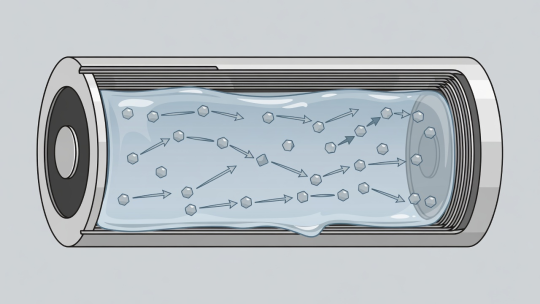 Electrochemistry at -15 °C
How Freezing Temperatures Affect Lithium-Ion Cells
Inside every lithium-ion pouch, prismatic or cylindrical cell, lithium ions travel between the cathode and the graphite anode through a liquid organic carbonate electrolyte. As cell temperature drops below 0 °C, that electrolyte becomes more viscous and charge-transfer resistance at the solid-electrolyte interphase (SEI) rises sharply.
Higher internal resistance causes voltage to sag earlier under load. Because the Battery Management System (BMS) stops discharging when cell voltage hits a protective lower cutoff, a cold-soaked battery reaches that voltage floor before all stored chemical energy can be extracted. Some vehicles denote this temporary reserve with a snowflake icon or a shaded segment on the state-of-charge bar; once driving or active heating warms the pack back toward +15 °C, that capacity becomes accessible again.
 Energy recovery
Why Regenerative Braking Shrinks on Cold Mornings
Regenerative braking is high-current fast charging in miniature. When you lift off the accelerator approaching a roundabout, the traction motor acts as a generator and pushes tens of kilowatts back into the pack over a few seconds.
In a sub-zero battery, forcing high current into cold graphite anodes risks metallic lithium plating—microscopic deposits that permanently reduce cell capacity. To protect the pack, the BMS restricts or disables regenerative braking until cell temperature rises. On urban routes with frequent stops, reduced regeneration accounts for 5% to 8% of winter efficiency loss, and also means your friction brake pads do more work during the first few kilometres.
NMC/NCA vs LFP Packs in Freezing Climates
Automakers generally equip standard-range models with Lithium Iron Phosphate (LFP) cells and long-range or all-wheel-drive variants with Nickel Manganese Cobalt (NMC) or Nickel Cobalt Aluminium (NCA) cells. Both chemistries handle serious winters reliably when paired with active liquid thermal management, but they ask for slightly different owner habits.
| Characteristic | NMC / NCA (Nickel-Rich Ternary) | LFP (Lithium Iron Phosphate) |
|---|---|---|
| Energy Density & Mass | Higher gravimetric density; common in 75–105 kWh long-range packs. | Heavier per kWh; common in 50–65 kWh standard-range packs. |
| Cold Discharge Voltage Curve | Sloped voltage curve makes SoC estimation accurate even at -20 °C. | Very flat voltage plateau; requires periodic 100% charge to calibrate BMS SoC gauge. |
| Cold Charge Acceptance (0 °C to -15 °C) | Accepts moderate current earlier; reaches peak DC rate around +20 °C to +25 °C pack temp. | More sensitive to cold anode plating; needs active pack heating to +15 °C before strong DC intake. |
| Recommended Daily Winter Target | 70% to 80% for daily use; 90% to 100% immediately prior to long snow trips. | Charge to 100% at least once a week (or as specified in manual) to keep range predictions accurate. |
Aerodynamic Density, Snow Slush and Trip Length
Even if a battery pack were magically kept at +22 °C all winter without using a single watt of energy, an electric vehicle would still consume more electricity per kilometre in January than in August. That is because external physics works harder against the car:
- Cold Air Density: Dry air at -20 °C has a density of approximately 1.395 kg/m³, compared with 1.204 kg/m³ at +20 °C—an increase of nearly 16%. At 110 km/h on a cleared winter motorway, aerodynamic drag accounts for well over half of total traction load, directly raising kWh/100 km consumption.
- Slush and Packed Snow Displacement: Driving through 2 cm of wet slush or unploughed snow forces the tyres to continuously compress and displace mass, which can increase rolling resistance by 20% to 40%. Lowering speed by 10 to 15 km/h in heavy slush both preserves stability margin and sharply trims consumption.
- Short-Trip Thermal Overhead: Heating a cold cabin from -10 °C to +20 °C typically consumes 1.5 to 2.5 kWh over the first 15 minutes. If your trip is only 8 km long and takes 15 minutes, that warm-up energy adds 18 to 30 kWh/100 km to your average consumption. Over a 200 km journey, the exact same initial warm-up spreads across the distance and adds barely 1 kWh/100 km.
Real-world winter range tests such as the Norwegian NAF Elbiltesten—which drives dozens of production EVs simultaneously from Oslo up into the mountain passes of Rondane and Dovrefjell until battery depletion—consistently demonstrate that vehicles tested under identical sub-zero road conditions experience between 12% and 36% highway range reduction compared with official WLTP figures. Treating WLTP or EPA numbers as warm-weather baselines and subtracting 25% for regular freezing highway trips and 35–40% for short urban errands gives you a calm, dependable planning rule.